Vendor lock-in just shifts from cloud provider to hardware vendor
Replacing public cloud lock-in with proprietary NOS or hardware lock-in on the network layer is not a real private cloud strategy.
Most organisations are escaping the public cloud cost spiral. But private and hybrid cloud only delivers on its promise when the network underneath is fast, programmable, and operationally manageable.
PalC builds that network: open, SONiC-based, EVPN-VXLAN driven, Kubernetes-native, and designed from day one for cloud-grade workloads.
Moving workloads to private infrastructure solves the cost problem, but most organisations hit a wall when the network cannot keep up. That bottleneck undermines every other investment.
Replacing public cloud lock-in with proprietary NOS or hardware lock-in on the network layer is not a real private cloud strategy.
Every layer introduces a different interface, licence model, and support contract. Complexity grows faster than the platform value.
AI, Kubernetes east-west traffic, and multi-tenant workloads require deterministic low-latency networking. Legacy stacks become the bottleneck.
Moving workloads off public cloud requires protocol-level network engineering that most infrastructure teams do not have in-house.
The network is the connective tissue that touches every other layer. When it is open, programmable, and Kubernetes-native, private cloud becomes simpler to operate, scale, and evolve.
PalC engineers the open networking foundation that makes private and hybrid cloud actually deliver on its cost and performance promises.
Own the NOS and keep hardware choice open with SONiC and EVPN-VXLAN.
Kubernetes-native policy, visibility, and east-west control without overlay sprawl.
Keep traffic inside defined boundaries with segmentation, control, and auditability.
Terraform, Helm, Kubernetes, and ArgoCD delivered through one GitOps pipeline.
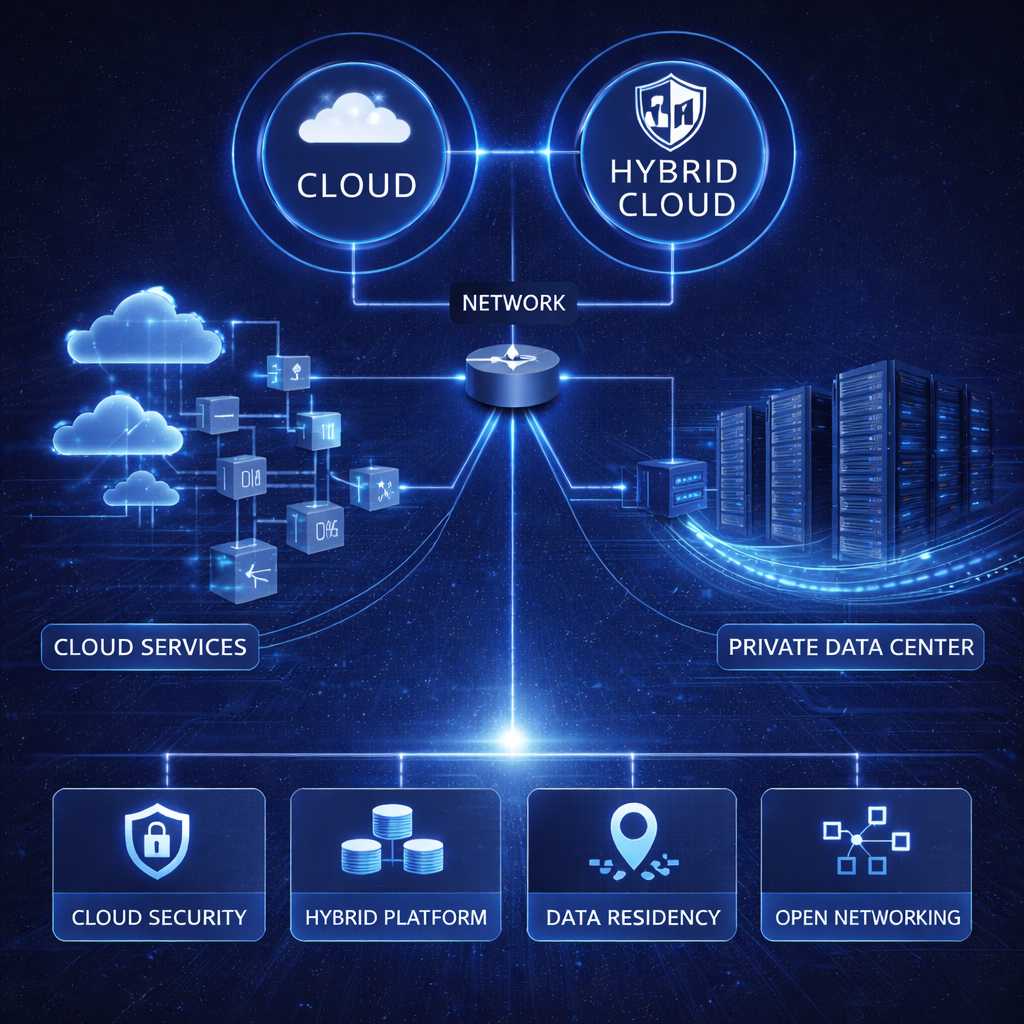
PalC delivers the open networking foundation that connects private cloud, hybrid connectivity, workload orchestration, storage, and policy-driven operations.
Click a component in the diagram or panel to explore details.
Components
Private cloud, edge, and on-prem infrastructure layer for controlled workload placement.
On-premises infrastructure foundation.
Secure interconnect between on-prem, edge, and public cloud environments.
Connectivity bridge across hybrid environments.
Programmable VPC-style architecture powered by SONiC and EVPN-VXLAN overlays.
Core differentiator in the hybrid cloud stack.
Kubernetes, KVM, and container runtimes for multi-workload support.
Workload orchestration layer.
Distributed and software-defined storage for hybrid workloads.
Data persistence layer.
Unified visibility, policy control, and compliance operations across environments.
Security and governance.
Public cloud cost overruns only become private cloud savings when the underlying network is designed for cloud-grade operations from day one.
Government, BFSI, and healthcare organisations need the network layer to enforce residency, segmentation, and security controls from day one.
All-reduce operations, model checkpointing, and high-throughput training jobs all depend on fast, lossless east-west networking.
Most VMware exits fail because networking is treated as an afterthought. PalC plans network migration in parallel with compute and operations.
PalC engineers alongside your team from assessment through production handover.
We map the current network, compute, and workload state before designing anything.
SONiC leaf-spine, EVPN-VXLAN, Cilium policy, and IaC patterns are defined with your team.
Phased delivery with validation first, staged cutover, and network migration aligned with compute.
Runbooks, telemetry, dashboards, and enablement make the platform sustainable long term.
Less public cloud egress and better use of owned infrastructure reduce spend for compute-heavy workloads.
Every byte stays inside defined boundaries and remains auditable from day one.
Open SONiC runs on whitebox hardware so you can change vendors without redesigning the stack.
Merchant silicon plus EVPN-VXLAN and eBPF networking support demanding application paths.
IaC-first delivery reduces provisioning time and keeps network and compute in the same pipeline.
Hubble flow logs, gNMI telemetry, and dashboards create one operational view across the stack.
Most integrators can install cloud tooling. Very few can design and operate the open network fabric underneath it at the protocol level. That is PalC’s core capability.
PalC has built and maintained SONiC NOS and deployed SONiC-based fabrics in production carrier and enterprise environments.
When BGP EVPN is not converging or VXLAN drops packets under load, PalC can diagnose the protocol layer directly.
PalC designs have been deployed in national-scale payment platforms, regulated enterprises, and AI GPU clusters.
Every engagement includes knowledge transfer, runbooks, and team enablement so your team is not perpetually dependent on PalC.
| Capability | Our Solution | Public Cloud | Proprietary NOS |
|---|---|---|---|
| Open NOS — no vendor lock-in | SONiC | No | No |
| Full data sovereignty control | Full | Partial | Conditional |
| Protocol-level BGP / EVPN engineering | Native | No | Vendor only |
| Kubernetes-native Cilium networking | eBPF | Managed only | No |
| Predictable total cost | CapEx model | Variable egress | Licence heavy |
| Hardware vendor flexibility | Any whitebox | N/A | Vendor-locked |
| IaC-first / GitOps delivery | Always | Limited | Add-on tools |
| Flow-level observability | Hubble + gNMI | Charged extra | Partial |
Deployments across AI fabrics, multi-cloud, automation, and security.
ODM PARTNERS










TRUSTED BY LEADING TECHNOLOGY PARTNERS



































Next steps
PalC helps enterprises design open, scalable, and high-performance cloud infrastructure with stronger operational control and predictable economics.

Connect with our experts to discuss your network modernization, SONiC deployment, or AI infrastructure needs.
Tell us about your infrastructure challenges and we'll connect you with our experts.